
The kingdom
Deheubarth was a kingdom combined under Hywel as various areas inherited from his father and brother and brought to him by his wife [Elen, daughter of the king of Dyfed]. He combined the kingdom to be Deheubarth by 920.
By the time of his death in 950 he had added Gwynedd and most of Powys to his kingdom thus ruled a large proportion of the current area of Wales.
Hywel Dda
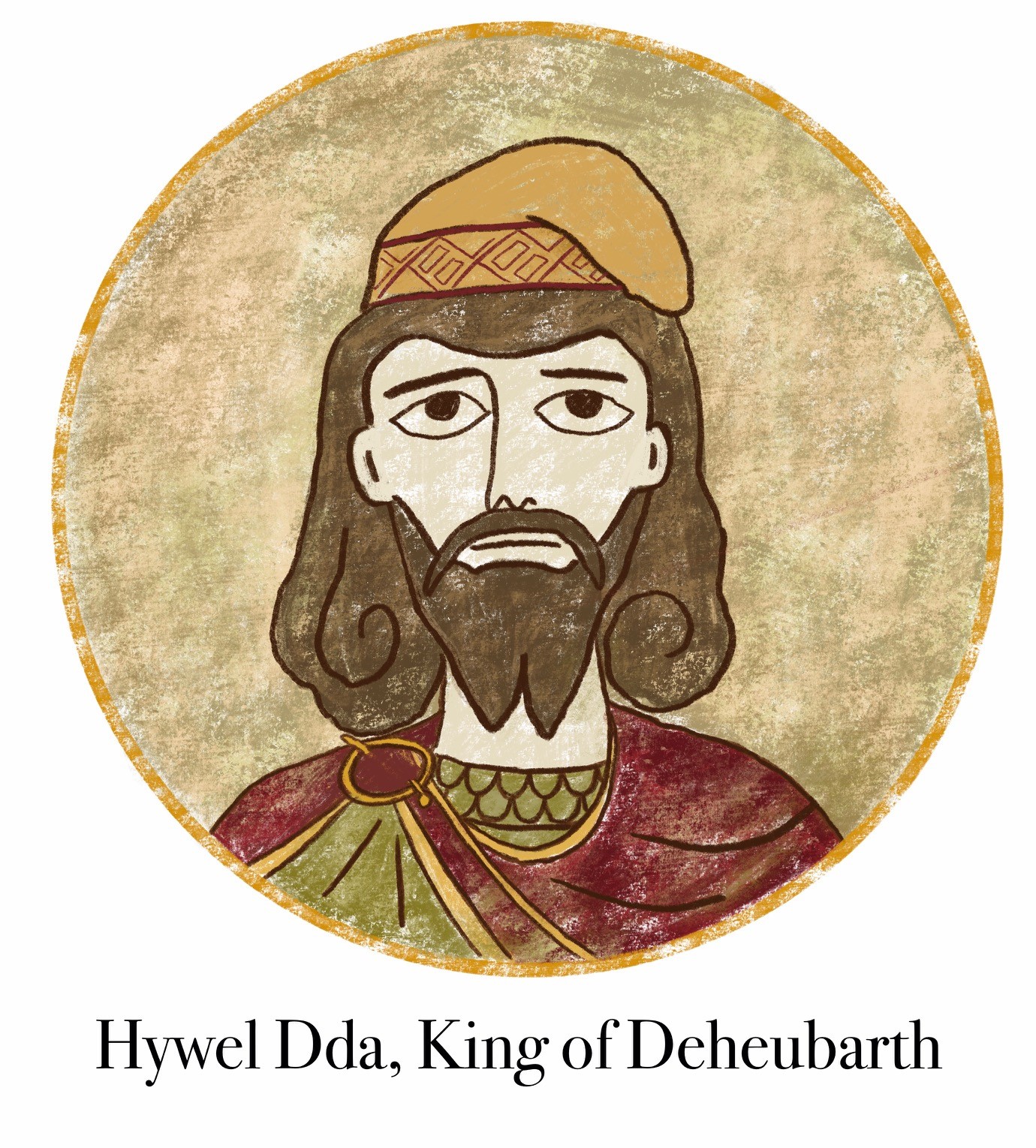
Hywel was one of the great kings of Welsh history. He lived a long time, being about 65 years old at his death, which enabled him to assemble a large area for his final kingdom. The inheritance system in Wales in this period was for a kingdom to be split between all the sons, and sometimes the daughters, at a king’s death. Thus, the ruled lands were a constantly shifting patchwork of small areas.
Early life
Hywel was born in about 885 to King Cadell of Seisyllwg. Cadell was a son of Rhodri the Great of Gwynedd who had installed Cadell in Seisyllwg when the ruling house there died out. It appears that Hywel took control of Dyfed in 904 having married the daughter, Elen, of the previous king. Then in 911 Cadell died and left his kingdom to be shared between his sons Hywel and Clydog. Hywel first appears in the Anglo-saxon records as “submitting” to Edward, Athelstan’s father, in 918 together with his brother Clydog.
Inheriting Seisyllwg
In 920 it appears that Clydog died without heirs and thus Hywel inherited all of Seisyllwg and he created the kingdom of Deheubarth. His seat was Dinefwr castle above the river Tywi [or Towy] near the modern town of Llandeilo.
Hywel reappears with other Welsh kings witnessing charters at Athelstan’s court in 926. He was well educated speaking English and Latin in addition to Welsh. He must have impressed Athelstan for him to be the only Welsh king to be asked to attend the meeting at Eamont.
Hywel the Good
Known in Wales now as Hywel Dda [Hywel the Good] legend credits him with codifying many of the laws of that time. There is no record of this, but his name has long been associated with Welsh Law. That would have been a shared interest between Hywel and Athelstan and there are records of Hywel attending Athelstan’s court and signing charters until Athelstan’s death. Hywel’s youngest son was named Edwin, an Anglo-Saxon name, which may also show his closeness to Athelstan.
Hywel visited Rome in 928 which was a prestigious trip to make and he is the only recorded Welsh king to make the visit and return. This would also have created a bond with Athelstan who was deeply religious. It additionally shows the firmness of Hywel’s grip on his kingdom in that he could make a long foreign trip without concern about his land being seized by a rival.
Hywel died in 950 having dominated Wales but leaving his large kingdom to be split between his three sons and a couple of cousins!