The kingdom
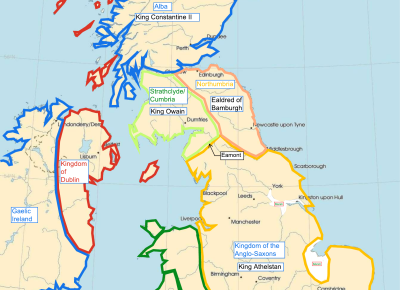
Alba in 927 covered Scotland above the Firth of Forth so its southern border was with Strathclyde and the Firth of Forth. The northern border is vague and it is not clear if any of the islands were part of Alba.
There had been a lot of fighting over this area but Constantine’s grandfather, Kenneth MacAlpin had emerged as the main kingdom across northern Scotland in 843, which was then known as the kingdom of the Picts. In Constantine’s lifetime it became the Kingdom of Alba. Alba is the Gaelic version of Albion which is the name of the whole of Britain so Constantine was obviously thinking big. Gaelic had come in with a people that had come from Ireland [the other Gaelic speaking area] and then appear to have replaced the Brittonic speaking Picts.
But also in Constantine’s lifetime there is the first reference to Scotia or Scotland, which seems to refer to the Gaelic speakers from Ireland, and the descendants of Kenneth MacAlpin eventually called themselves Kings of Scotland. They also took over Strathclyde and a chunk of Northumbria. Thus a dynasty on the make.
Constantine II

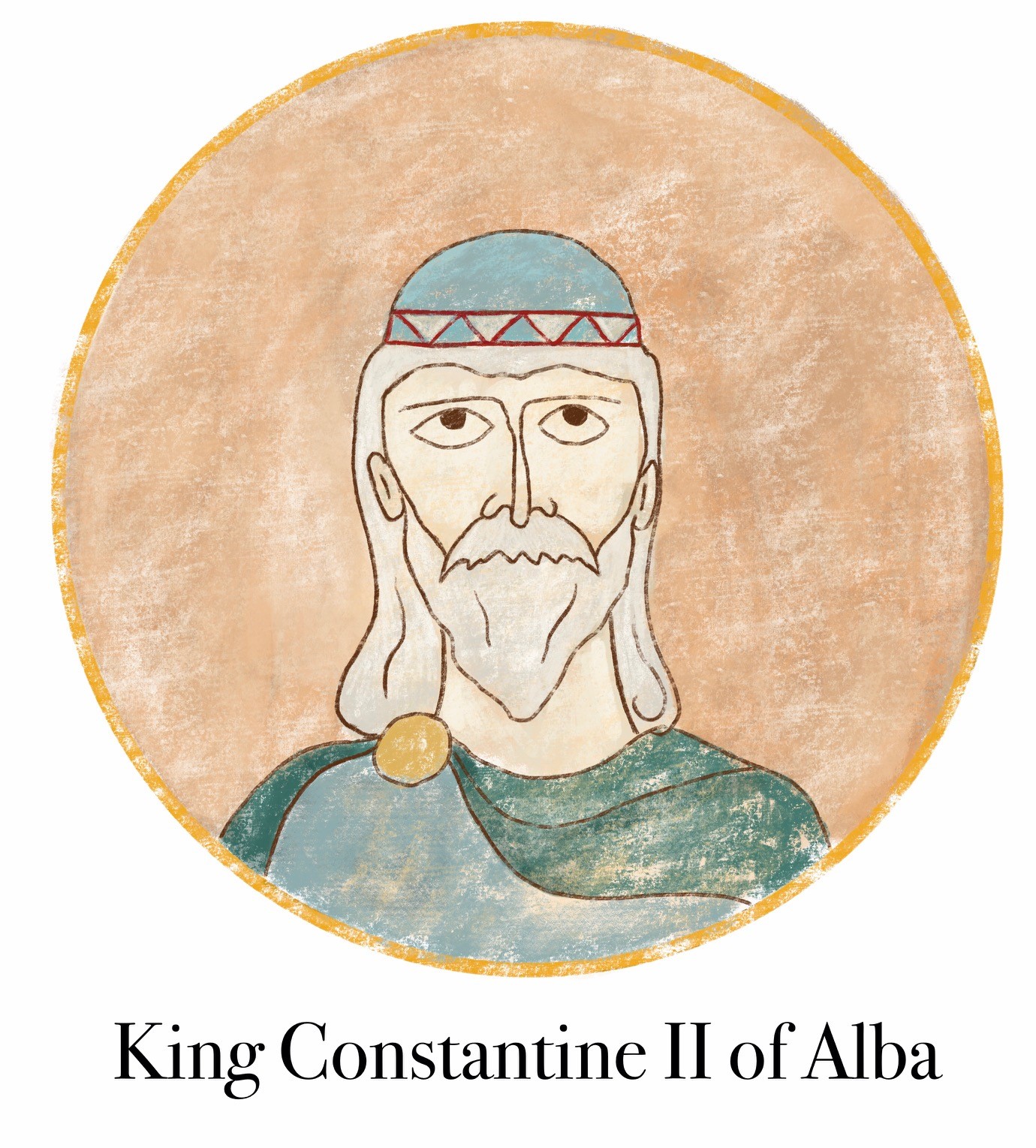
Constantine II was born before 878 and became king in 900 reigning till 943. Hence a long-lived experienced king when he arrived at Eamont. Constantine’s father Aed died in 878 and the line of succession before Constantine took the throne in 900 is unclear. Constantine’s main claim to the throne was that his father Aed was the son of Kenneth.
Seat of Alba
The seat of Alba was at Scone, on the Tay near Perth. The Stone of Scone was used as a coronation seat maybe from Kenneth MacAlpin’s time. [but there is no record of its use before 1249] In 906 Constantine had an Assembly at Scone on The hill of belief so we can maybe assume that there was a hill with the Stone, a large rectangular block of red sandstone at that time.
There are no records from that period in Scotland apart from “The list of the kings of Alba” so most of the information about Constantine is gleaned from the Annals of Ulster or the Anglo-Saxon Chronicle.
In 918 the Lady of the Mercians, Athelflaed, organised an alliance between Mercia, Strathclyde and Alba as a mutual defence against the Vikings – both the Norse from Ireland and those actually residing in Britain. Hence Owain of Strathclyde and Constantine II must have known and negotiated with Athelflaed. Then after her death Edward held a meeting at Bakewell in Derbyshire with the king of Alba [Constantine II], the king of the Strathclyde Welsh [Owain], the sons of Eadwulf [assumed Ealdred and a brother Uhtred] and Ragnall the Viking who held southern Northumbria. Presumably this was to agree boundaries. Maybe Constantine met Athelstan at his father’s or aunt’s courts.
The heir of Sihtric King of York, who had succeeded Ragnall, was Guthfrith [Or Gofraid, this appears to be the same name] King in Dublin. Guthfrith had fought alongside Ragnall at the Battle of Corbridge in 918 against Constantine and Ealdred. [Result indecisive but Ragnall got York and Ealdred stayed in Bamburgh] In 927 when Sihtric had died the Irish annals record that Guthfrith left Ireland that year, along with a great many others from Dublin to claim Sihtric’s throne. Then Guthfrith returned after only six months abroad.
A later account by William of Malmesbury tells a different story. In his version, Guthfrith goes to “Scotia” following Sihtric’s death, to attend a meeting at Dacre with Æthelstan, Constantine II of Scotland, and Owain of Strathclyde. Instead, he and a Viking ally called Thurfrith lead a force to York and besiege the city. Æthelstan turns on the Vikings and Guthfrith is captured. The city is looted by the Anglo-Saxons and Guthfrith is allowed to return to Ireland under oath. It is not certain how much of William’s account is based on historical sources and how much is from folk story or popular songs.
More modern interpretation of the Annals [contemporaneous and thus more reliable] combined with William’s story has Athelstan fighting Guthfrith at York and evicting Guthfrith so quickly he couldn’t make it back to Dublin and thus fled to Scotland and took refuge in Alba. In this version one of the reasons for Athelstan calling the meeting at Eamont was to ask the Scots for the return of Guthfrith.
The Anglo-Saxon Chronicle lists Constantine as the most important king after Athelstan present at Eamont. And he is the only other king mentioned in the poem Carta Dirige Dressus written after the Eamont meeting. William of Malmesbury also reports that Athelstan became the godfather of Constantine’s son Indulf at Dacre.
In 934 Athelstan marched north and invaded both Strathclyde and Alba and by the end of 934 Constantine was in Buckingham with Athelstan. He was also in Cirencester in 935 but this is the last time he was recorded at Athelstan’s court. His presence in England is usually taken that Athelstan won any battle that had been fought in 934.
In 937 Constantine together with Owain of Strathclyde and Olaf son of Guthfrith, King in Dublin invaded England and fought Athelstan in the Battle of Brunanburh. This was a terrible battle with huge losses on both sides but was accepted by the Annals of Ulster as well as the Anglo-Saxon Chronicle that Athelstan won. It appears that Owain was killed in the battle along with a son of Constantine, probably Cellach.
Constantine abdicated in 943 as he was an old man and went into a monastery and was succeeded by his nephew Malcolm I as his son Indulf was too young. Constantine died in 952, the last of the 5 men who met at Eamont in 927.