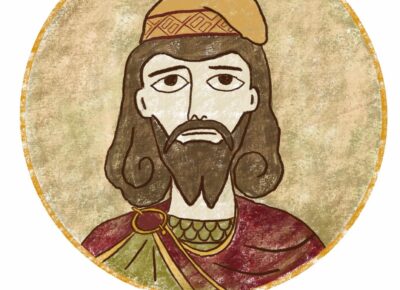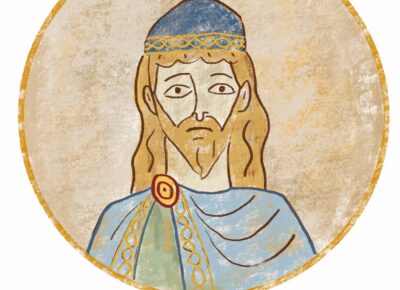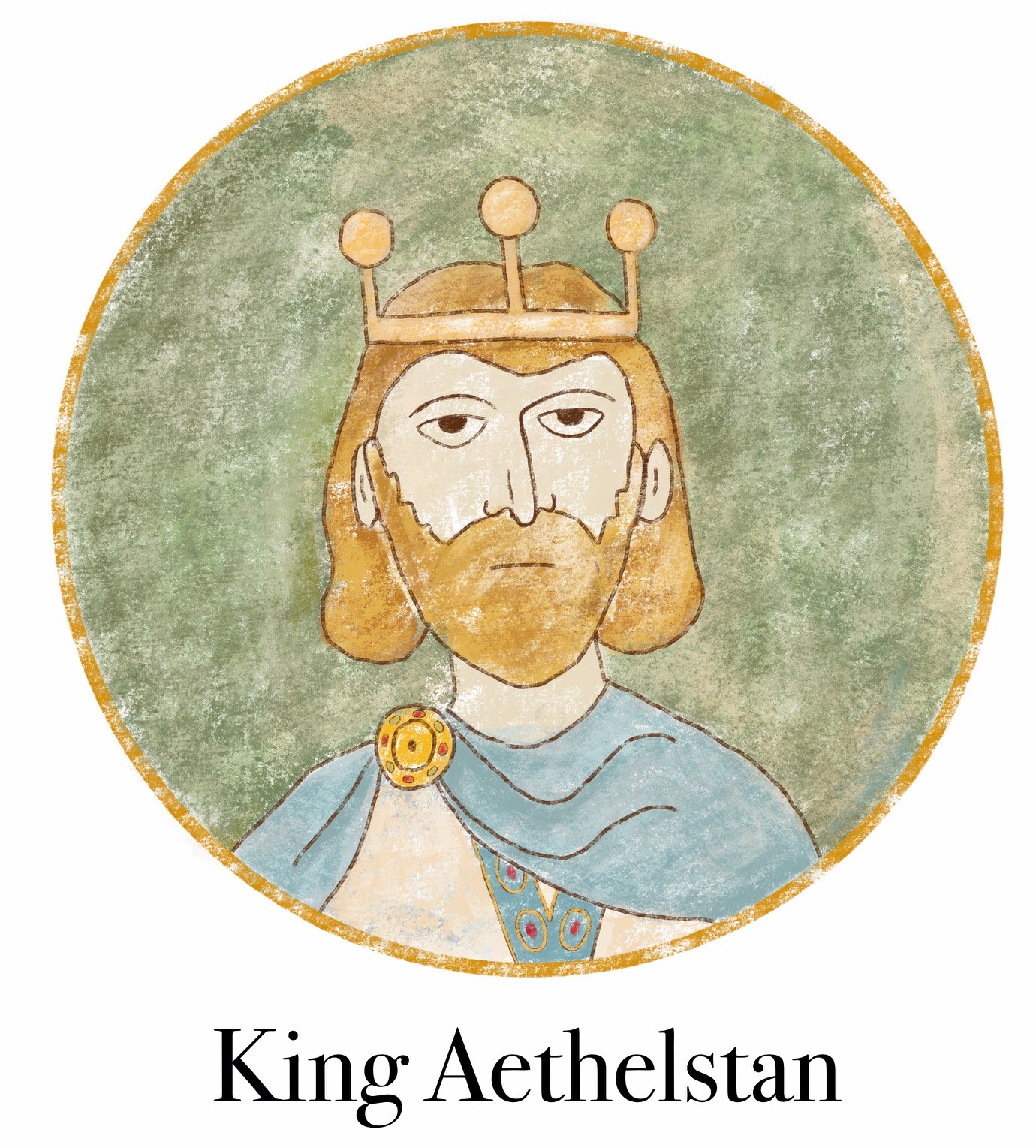

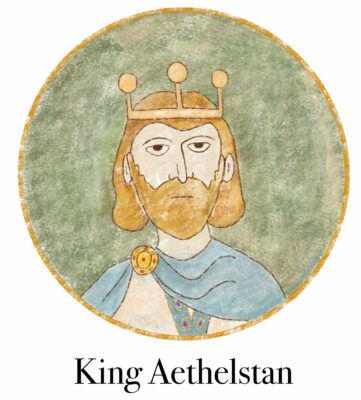
Portrait in frontispiece of Gospel that Athelstan gave to the shrine of St Cuthbert
The Early Life of Æthelstan
Æthelstan, often regarded as the first true King of England, was born around 894 AD. He was the eldest son of Edward the Elder and the grandson of Alfred the Great. His mother, Ecgwynn, appears to have been of lower noble status than Edward’s later wives, which later caused questions over Æthelstan’s legitimacy and claim to the throne.
From an early age, Æthelstan was marked out for leadership. Medieval chroniclers described him as intelligent, graceful and exceptionally well educated. According to later accounts, Alfred the Great himself showed special affection towards the young prince and publicly honoured him with royal gifts.
Upbringing in Mercia
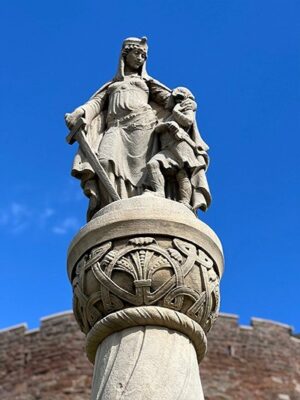
Rather than being raised entirely in Wessex, Æthelstan spent much of his youth in the kingdom of Mercia under the care of his aunt Æthelflæd and her husband Æthelred. Mercia had long been one of the great Early Medieval kingdoms, and during Æthelstan’s upbringing it stood at the forefront of resistance against Norse expansion.
At the Mercian court, Æthelstan received both military and scholarly training. He learned Latin, Christian theology, kingship, and warfare, while also gaining first-hand experience of campaigns against Norse-held territories. Æthelflæd and Æthelred had built fortified burhs across Mercia and led successful operations against Norse forces, giving the young prince invaluable experience in leadership and strategy.
Mercia would shape Æthelstan’s identity throughout his life. Unlike many West Saxon kings before him, he developed close ties with both Mercians and West Saxons, helping him later unite the English kingdoms under a single ruler.
The Death of Edward and the Struggle for the Throne
When Æthelstan’s father, Edward the Elder, died in 924, the succession was not straightforward. Although Æthelstan was the eldest son, his mother Ecgwynn was probably not considered a fully royal wife by some West Saxon nobles. This created uncertainty over whether Æthelstan was the rightful heir. Meanwhile, his younger half-brother Ælfweard had staunch support in Wessex.
Mercia immediately accepted Æthelstan as king, largely because he had been raised there under Æthelflæd’s protection and was already well known to Mercian nobles. Wessex, however, hesitated. Some sources suggest there may even have been plans to exclude him from the throne altogether.
Then, only weeks after Edward’s death, Ælfweard himself died. That removed the immediate rival, but resistance to Æthelstan did not vanish overnight. His coronation was delayed for around a year, which was highly unusual for an Early Medieval king. This delay strongly suggests political opposition behind the scenes.
The Coronation at Kingston upon Thames
Æthelstan was finally crowned on 4 September 925 at Kingston upon Thames, a place carefully chosen because it stood near the boundary between Mercia and Wessex. Symbolically, it represented unity between the two great Early Medieval kingdoms.
The ceremony itself was groundbreaking. Historians believe it introduced a much more elaborate style of royal consecration influenced by Carolingian Europe and church ritual. The king was presented not simply as a war leader, but as God’s chosen ruler over all the English peoples. This coronation helped establish ideas of sacred kingship that later English monarchs would continue to use for centuries.
The Missing Helmet
The story about Æthelstan not receiving a helmet comes from comparisons with earlier royal traditions and from descriptions connected to Alfred the Great.
According to later medieval traditions, Alfred had once honoured the young Æthelstan with princely gifts including a purple cloak, a jewelled belt, a sword with a golden scabbard,and a Saxon spear.
Notably absent from these gifts was the ceremonial helmet often associated with Germanic warrior kingship.
For earlier Early Medieval rulers, the helmet symbolised the king as a battlefield warlord — a leader whose authority came largely through military prowess and personal loyalty in war. Famous examples such as the Sutton Hoo helmet represent this heroic warrior culture.
By Æthelstan’s reign, however, kingship was changing.
A Different Kind of King
Æthelstan deliberately projected a new image of monarchy. Rather than focusing purely on warrior symbolism, his rule emphasised: Christian kingship, law and administration, diplomacy, learning, and imperial authority.
His coronation reflected this shift. Church ceremony, sacred anointing, relics, and royal regalia became more important than traditional Germanic military symbols like helmets.
That does not mean Æthelstan was not a warrior — he absolutely was. He later became one of the greatest military kings in English history, especially after his victory at the Battle of Brunanburh in 937. But his authority was presented as broader and more sophisticated than that of earlier Early Medieval warlords.
In effect, Æthelstan stood between two worlds: the older heroic warrior culture of early Saxon England, and the emerging medieval idea of a divinely appointed Christian monarch.
The absence of the helmet in royal symbolism reflects that transition.
Conquest of York and the Creation of England
After years of conflict between the West-Saxon kingdom of Wessex and the Norse rulers of northern England, Edward the Elder and later his son Æthelstan were steadily expanding their control northward.
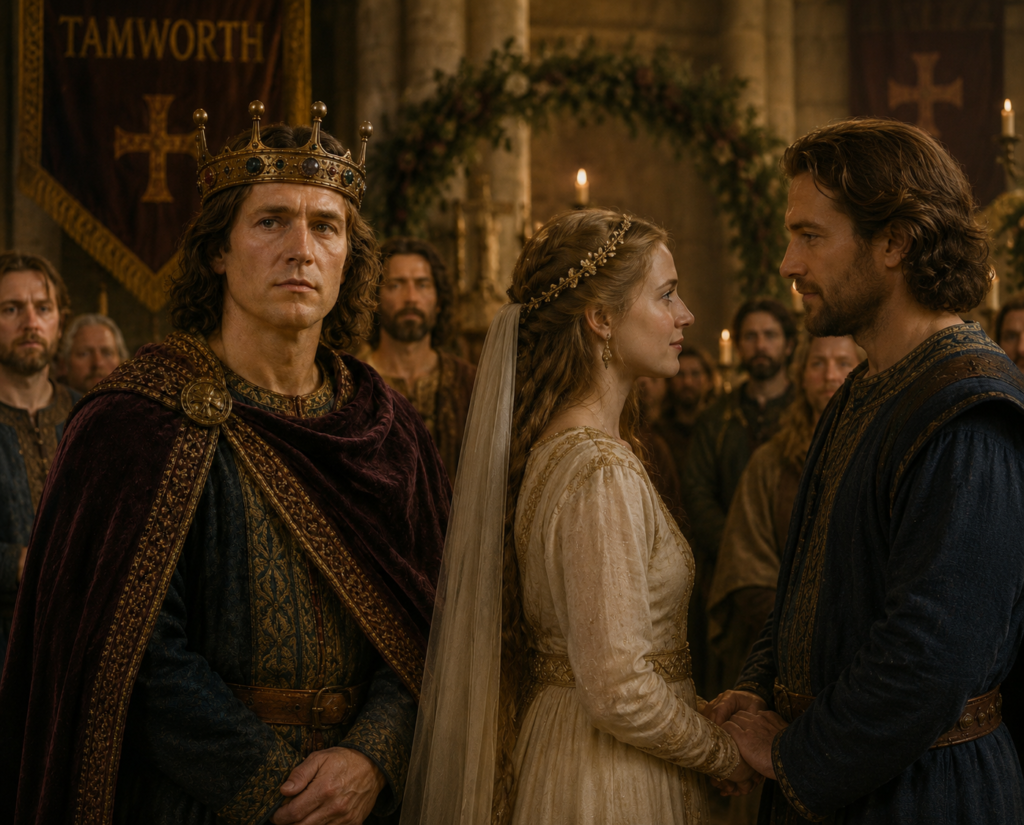
York, the capital of the Norse kingdom of Jórvík, remained outside their authority. It was ruled by the Norse king Sihtric Cáech. In 926, Æthelstan arranged for one of his sisters — often identified in later sources as Edith or possibly unnamed in contemporary records — to marry Sihtric at Tamworth. The marriage was politically significant because it created a temporary peace between Wessex and York. It recognized Sihtric as a legitimate ruler while tying him diplomatically to Æthelstan’s house. It may have involved Sihtric agreeing to convert to Christianity, though sources differ on this. For Æthelstan, this was a strategic pause rather than a surrender of claims over Northumbria.
Sihtric’s Death
Sihtric’s sudden death changed everything. Only about a year later, in 927, Sihtric died unexpectedly. His death caused a succession crisis in York. Rival Norse claimants emerged and the kingdom became unstable. Æthelstan suddenly lost the diplomatic bridge created by the marriage. Rather than allow another powerful Norse ruler to establish himself in York, Æthelstan acted immediately. He marched north and seized York this was a turning point. It ended independent Norse rule in York for the moment, and it brought Northumbria under southern English control. It made Æthelstan the first ruler to govern nearly all of England.
Why the marriage matters historically
The marriage to Sihtric shows that Æthelstan used diplomacy as well as warfare. First, he tried alliance and dynastic politics, when that collapsed after Sihtric’s death, he used military force. The attack on York was therefore not sudden aggression alone — it followed a failed political settlement. That combination of diplomacy, opportunism, and military action was a major reason Æthelstan succeeded in creating a united English kingdom.
This was a turning point in British history. Previous rulers had controlled large parts of England, but no Early Medieval king had ever ruled both the south and the Norse north as one realm. Æthelstan now adopted the title Rex Anglorum.

Eamont Gathering in 927
The Gathering at Eamont in 927
Following his conquest of York, Æthelstan summoned the rulers of Britain to a grand meeting at Eamont near Penrith on 12 July 927. The site stood at a symbolic meeting point of rivers, roads and kingdoms in the north of England.
Among those attending was: Constantine II, Hywel Dda, Ealdred I and Owain of Strathclyde.
At Eamont these rulers recognised Æthelstan as their overlord and agreed to maintain peace. Contemporary writers and many modern historians see this moment as the symbolic birth of a united English kingdom. The meeting represented far more than a diplomatic summit. It demonstrated that Æthelstan had become the dominant ruler in Britain, respected – or feared – by kings across the island. Æthelstan utilised the phrase Rex Totius Britanniae on his coinage and official royal charters to assert his dominance.