Area of control
Northumbria had been the great power in Anglo-Saxon Britain stretching from the Forth down to the Humber and across to Cumbria and down to the Mersey. Northumbria had been united in about 600AD. The Venerable Bede lived in Jarrow 673-735 and wrote that Northumbria had been settled by the Angles with south of the Humber being settled by the Saxons. Thus, the state of Northumbria had never been ruled by the West Saxons but were connected to the southern kingdoms as they all spoke Old English, which was a dialect of a Germanic language. Bede also wrote a life of St Cuthbert to whom Alfred of Wessex had a great dedication. In 927 St Cuthbert’s body was at St Cuthbert’s Church, Chester-le-Street just to the south of Durham and was an important shrine for all the English speaking Christians.
The Northumbrian great families fought between themselves over the centuries about the succession to the crown and the crown changed between families several times. It was held by a northern Northumbrian when the Vikings first struck by sacking Lindesfarne in 793. Northumbria had been first united as one territory in about 600AD. But after the arrival of the Vikings it was eventually reduced to just the northern part.

England in 878
By 927 southern Northumbria was held by the Viking king in York with northern Northumbria [between the Forth and the Tees] held by the family at Bamburgh who were generally known as Lords or Reeves rather than Kings. Northern Northumbria was also cut off from the remainder of the Anglo-Saxons by the Norse held lands.

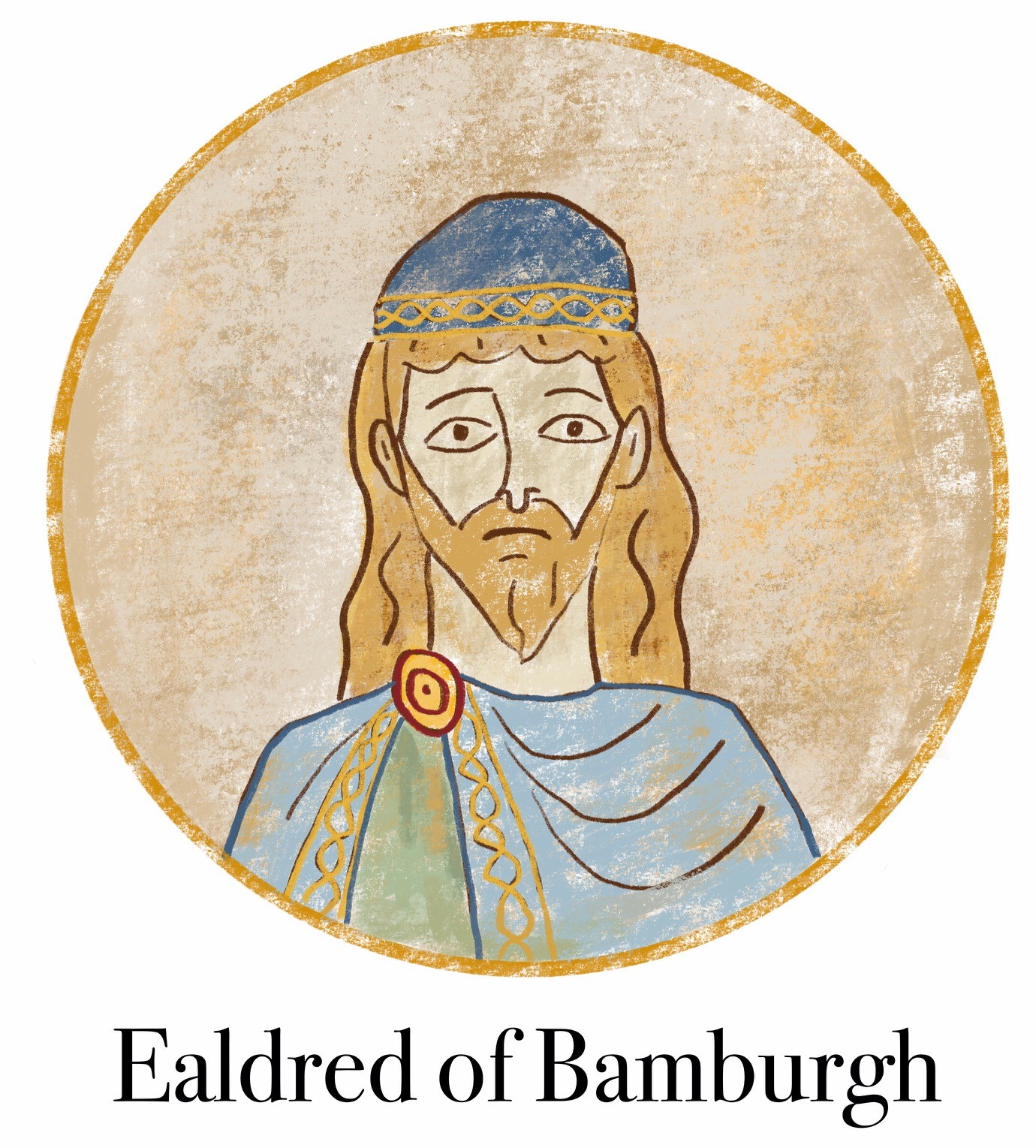
Ealdred
Ealdred had possibly inherited northern Northumbria in 913 from his father Eadwulf. Eadwulf was the grandson of Ella King of Northumbria through a daughter and thus part of the ‘kingly families’. Ealdred at some point after his accession had been attacked by the Viking Ragnall [or Ragnald] and possibly fled to the protection of Constantine II in Alba. Ragnall was a Norse prince from the family who held Dublin and he had acquired the Kingdom of York from another Norse family in 910.
In 918 Ealdred fought alongside Constantine against Ragnall at the Battle of Corbridge, as recorded in the Annals of Ulster. The battle appeared to be inconclusive as Ragnall retained York and the land from the Tees to the Humber but Ealdred moved back into northern Northumbria to his family’s stronghold of Bamburgh and held the land from the Forth to the Tees.
Bakewell Meeting
Then in 920 Edward, Athelstan’s father, held a great meeting in Bakewell, Derbyshire probably as another border consolidation negotiation. The people at Edward’s meeting were named in Manuscript A of the Anglo-Saxon Chronicle as – the king of Alba [Constantine II], the king of the Strathclyde Welsh [Owain], the sons of Eadwulf [assumed Ealdred and a brother Uhtred] and Ragnall himself. Presumably the boundaries were settled as Edward having taken up to Ragnall’s southern boundary of the Humber and also up to Manchester where he had set up a burgh [defended town].
In 921 Ragnall died but was succeeded by his brother Sihtric as King of York. And then in July 927 Ealdred is recorded by Manuscript D of the Anglo-Saxon Chronicle as being one of the participants at the meeting at Eamont. As Athelstan was declared King of the English after this Ealdred must have submitted to being a sub-king or merely a Lord running northern Northumbria on behalf of Athelstan.
After this Ealdred travelled south on various occasions to Athelstan’s court and witnessed several of Athelstan’s charters in 931 and 932. He died in about 933 or 934 leaving Northumbria to his brother Oswulf.